
Practical
How to Stop a Dumpster Wrecking Your Driveway
A loaded roll-off puts several tons on four small steel contact points. In Katy the driveway is only half the problem — the other half is the clay underneath it.
Why this matters here
Katy sits on some of the most expansive clay soil in the country, and that single fact shapes almost everything about placing heavy loads on a driveway here.
This clay swells when it takes on water and shrinks when it dries out. Over a wet spring and a dry August it can move measurably, and that movement is why foundation repair is such a routine homeowner project across Harris and Fort Bend Counties. Your driveway slab sits on the same ground, with none of the engineering a house foundation gets.
The result: a driveway that looks perfectly sound can be sitting over a subgrade that has moved, voided or softened. You cannot see it from the surface.
How the damage actually happens
People picture the container's weight spread across its footprint. It is not. A roll-off sits on two steel rails and concentrates load at a small number of contact points — typically the rear wheels and the front of the rails.
A 20 yard loaded to four tons, plus the container's own weight, puts something in the order of several thousand pounds onto each of those points. Three mechanisms follow:
- Static load. The container sitting there over days, gradually pressing in.
- Dynamic load during delivery. The moment the container rolls off and the rear wheels touch down is the highest instantaneous load of the whole rental.
- Dragging. Winching the container back on drags the rails across the surface. On decorative concrete this is what causes scoring.
What protection boards do
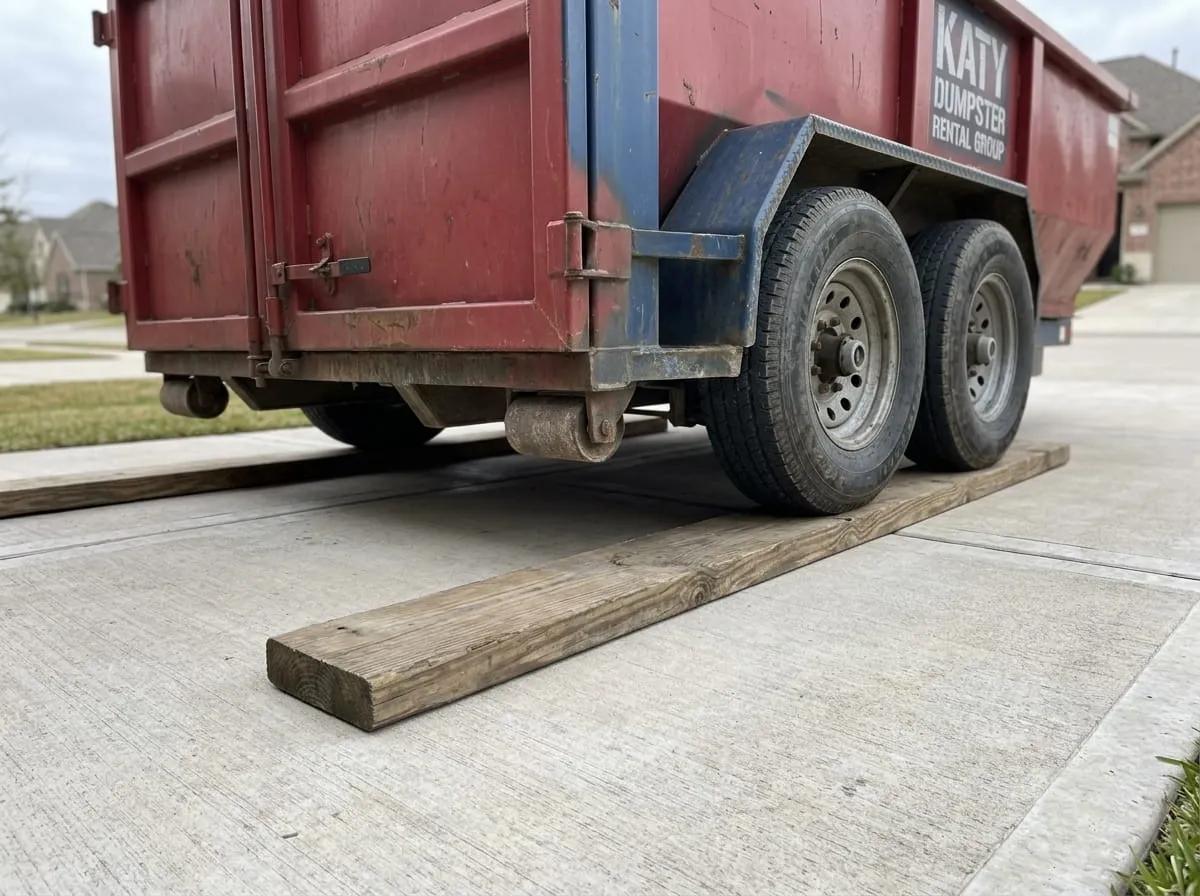
Plywood under the rails spreads a point load across a much larger area. It is unglamorous and extremely effective — the difference between several thousand pounds on four small contacts and the same weight distributed across several square feet.
Our drivers carry plywood on every truck as standard equipment. Boards go down before the container touches the surface, not afterwards, and they go down again on collection because the drag-on is as damaging as the drop-off. On pavers, stamped and decorative concrete we double up.
Expansive clay: the local problem
Two situations to watch for.
After sustained rain, the clay takes on water and softens. A concrete drive over saturated clay can crack because the support beneath it has gone. A gravel drive will rut deeply. A lawn placement will leave marks for months, and in bad cases the truck itself gets stuck — which turns a routine delivery into a recovery operation and does far more damage than the container ever would.
After a long dry spell, the opposite: the clay shrinks and pulls away, sometimes leaving voids under the edges of a slab. That is why you see gaps opening beside driveways and patios in a Texas August. A slab with a void under it will fail under a point load that it would have carried fine in April.
Surface by surface
Concrete driveway
Generally fine with boards down. Watch for existing cracks and separation at the slab edges. A slab that is already cracked will preferentially fail along that line.
Pavers and stamped concrete
Common in the master-planned communities. The units are strong; the bedding sand is not. Doubled boards as standard, and we lift rather than drag where possible.
Gravel and chip-and-seal
Common on rural property out toward Pattison, Brookshire and Sealy. Generally forgiving, with some displacement that rakes back. The caveat is what is underneath.
Grass and bare ground
Workable when firm and dry, and often the best option on acreage. Not after heavy rain.
Heat and asphalt
Worth its own note in this climate. Asphalt softens in heat, and a Katy summer delivers plenty of it. A container left on hot asphalt for a week can leave permanent depressions where the wheels and rails sit.
Boards are essential on asphalt in any season, and between roughly June and September we may suggest a different placement altogether, or a shorter rental period, on an asphalt drive.
What is underneath
Irrigation. Nearly universal on Katy lawns and shallow-buried. A lawn placement over a sprinkler line will crush it.
Septic systems. Common on the rural properties in Waller, Austin and western Fort Bend Counties. Never place over a tank or lateral field.
Utility laterals. Worth knowing where they run before a heavy container sits on them for a fortnight.
If something does go wrong
It is uncommon, but it happens. Tell us straight away rather than after the container is gone. Photograph it. We are licensed and insured, and where damage results from our placement we deal with it rather than arguing about it. Having before-and-after photographs makes that conversation short and civil.
What we cannot take responsibility for is damage from a hazard nobody told us about — an irrigation line we did not know was there, or a driveway already failing that we were not shown.
The short version
- Boards go under the rails on every delivery. If a hauler does not do this as standard, use a different hauler.
- Tell us about existing cracks and any separation at the slab edges.
- Tell us if the ground has been very wet or very dry — both are a problem here.
- Mention low branches. We need about twenty-two feet of clear height.
- Say where the irrigation runs.
- Photograph existing damage before delivery.
Need a container in Katy?
Call and describe the job. Three minutes on the phone gets you a size recommendation, a flat rate and a delivery window — and we will tell you if a smaller, cheaper container is the right answer.
Call (346) 279-1335