
Construction
Where Construction Debris Actually Goes Around Katy
The city will not take a single piece of it. Here is where construction debris has to go instead, and how the Texas landfill classes decide what you pay.
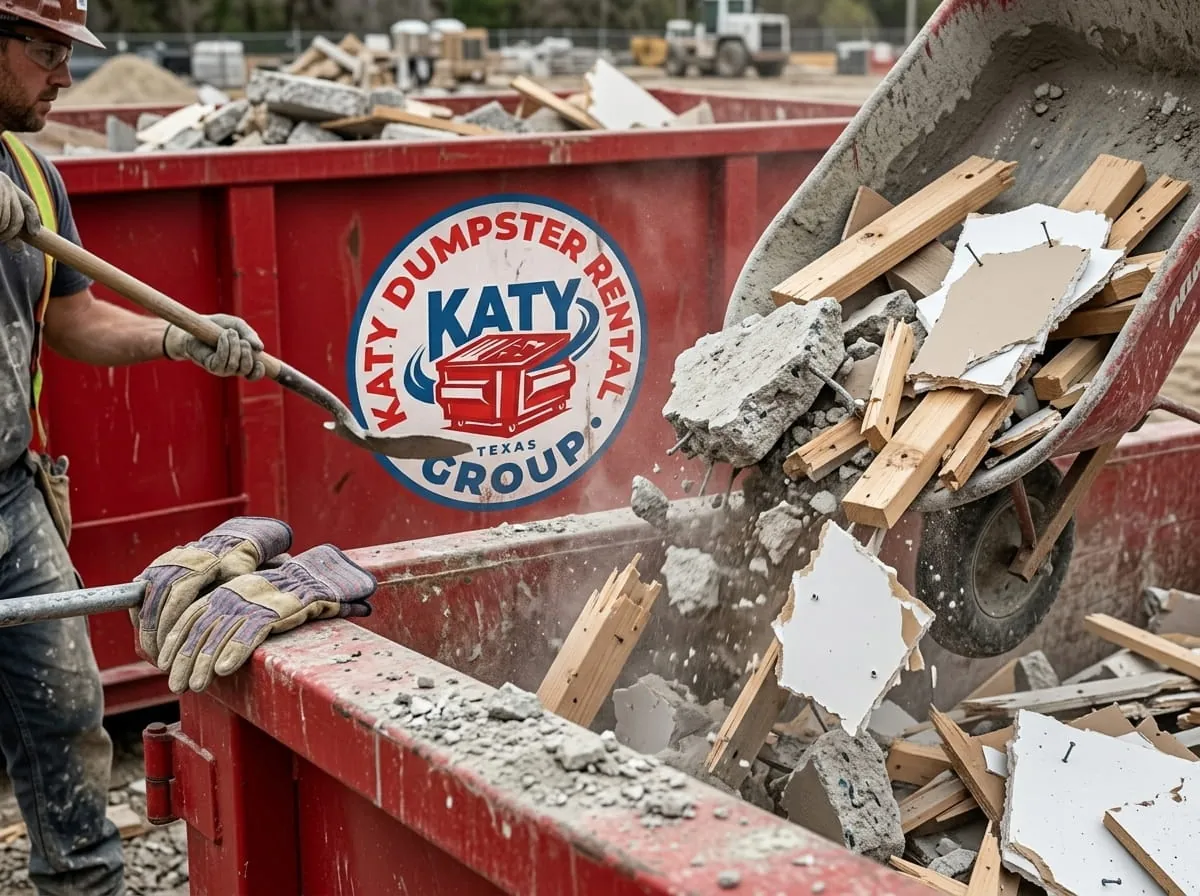
The city will not take it
Start here, because it is the fact that catches out more Katy homeowners than anything else.
The green cart, the recycling cart, heavy trash and yard debris collection are residential household services. Renovation and construction material sits entirely outside them. There is no version of the city service that takes your bathroom gut.
The city's own guidance points residents with large volumes toward a "pay pile" quote from the collection contractor, which is a route worth knowing about — but for anything that is genuinely construction debris, a roll-off container is the normal answer.
Type I and Type IV: why the class matters
Texas regulates landfills through the TCEQ, and for our purposes there are two classes that matter.
- Type I takes municipal solid waste. Waste is compacted and covered daily. It is the general-purpose class, and it is the more expensive one.
- Type IV takes brush, construction and demolition waste and rubbish that is free of putrescible and household waste. Cover is required weekly rather than daily.
That phrase — free of putrescible and household waste — is the whole game. A clean construction load can go to a Type IV site. Put a few bags of kitchen trash in with it and it is no longer eligible, so it goes to a Type I site instead at a higher rate.
This is why we ask what is going in the container, and why "just throw everything in" is sometimes an expensive instruction.
The regional disposal chain
Construction and demolition debris from the Katy area is typically handled through Fort Bend County facilities, which serve much of the western Houston region. The Houston-Galveston Area Council maintains the regional list of active Type I and Type IV landfills, transfer stations and citizens' collection stations across the counties we work in.
One local wrinkle from the Katy ordinance worth knowing: waste collected inside the city limits must be disposed of outside the city, and no hauling truck may sit in town overnight with a load in it. Practically that means every load leaves Katy the day it is collected, which is how it should work anyway.
If you want the paper trail on a particular job, ask for the weight ticket. Any hauler running licensed disposal can produce one.
Why stream separation saves money
Disposal is priced per ton and the rate varies by stream and by landfill class. Mixed debris is the most expensive. Clean inert material is cheaper. Scrap metal has positive value.
Consider a demolition producing eight tons of broken concrete and eight tons of mixed debris. All in one container and you have sixteen tons priced as mixed, at a Type I site. Split it and eight of those tons move to a cheaper stream. Even after paying for a second container movement, the split usually wins.
The break-even: if you have enough of a clean stream to substantially fill a dedicated container, separate it. A wheelbarrow load, do not bother.
The five streams worth separating
1. Clean concrete, block and masonry
Rebar is generally fine. Timber, plastic sheeting, soil and general debris are not. Goes in a 10 yard because of weight, always.
2. Scrap metal
Copper pipe, steel studs, ductwork, conduit, rebar offcuts and appliances. Often worth money rather than costing it.
3. Clean dimensional lumber
Untreated, unpainted, fasteners removed where practical. On a framing job in Fulshear or Cross Creek Ranch this is a large proportion of the waste stream. Treated timber does not qualify.
4. Cardboard and packaging
New construction generates an extraordinary amount — appliance boxes, fixture packaging, banding, shrink wrap. On a multi-unit build a dedicated container makes sense.
5. Clean brush and vegetation
Site clearing. Eligible for a Type IV site provided it is genuinely clean. Soil is what usually ruins a vegetation load's economics, so shake the roots out where you can.
Foundation and slab work
Worth its own section because it is so common in this region and it produces a debris profile people consistently mis-size.
The soil across Harris and Fort Bend Counties is expansive clay. It swells when wet and shrinks when dry, and over years that movement works on a slab foundation. Foundation repair — piers, underpinning, slab breakage — is a routine homeowner project here in a way it simply is not in other parts of the country.
What comes out is broken concrete, excavated spoil and old piers. All dense. A cubic yard of concrete runs about two tons, and soil is not much better. That is a 10 yard, filled between half and two-thirds, and we will tell you to stop well before it looks full.
Sizing for construction debris
Framing, drywall, packaging and general build waste: go big. A 30 yard, with swap-outs planned into the programme. Bulky and light, so you fill the volume long before the weight allowance.
Concrete, block, brick, tile and spoil: go small. A 10 yard, part-filled.
Most real jobs need both at different phases, which is why we would rather talk through the programme than take a single order.
Practical site setup
- Place containers where the work is, not where they are convenient for the truck. Labour spent walking debris across a site is the largest hidden cost in waste handling.
- Label them. A sheet of plywood marked CONCRETE ONLY prevents a great deal of expensive contamination — and contamination is exactly what pushes a load from Type IV to Type I.
- Brief the trades. One subcontractor throwing a lunch bag into the clean concrete container costs more than the briefing would have.
- Book swaps into the programme, not on the day you notice the can is full.
- Watch the ground. Gulf Coast clay holds water. A site access route that carried a loaded truck in August will not necessarily carry one after a wet week in May.
- Cover heavy loads if rain is coming. You pay for that water by the ton.
We are happy to help set that up — tell us the build programme and we will schedule around the trade sequence.
Need a container in Katy?
Call and describe the job. Three minutes on the phone gets you a size recommendation, a flat rate and a delivery window — and we will tell you if a smaller, cheaper container is the right answer.
Call (346) 279-1335